
Scaling Website Traffic with Programmatic SEO and AI Automation

The digital marketing landscape is undergoing a massive, undeniable paradigm shift. Gone are the days when publishing a handful of generic, 500-word blog posts a month would secure your spot on the first page of search results. In 2026, the game is entirely different. Scaling website traffic is no longer just a measure of sheer manual effort; it is entirely about your digital infrastructure. It is about building compounding, intelligent growth engines that work tirelessly in the background.
Just like in a high-stakes cricket match, winning isn’t always about trying to hit every single unpredictable delivery for a six. True success comes from building a rock-solid, reliable partnership at the crease, consistently rotating the strike, and accumulating runs over a long period. In the modern search engine ecosystem, Programmatic SEO and AI automation form that perfect, match-winning partnership. These methodologies allow you to capture thousands of highly targeted, long-tail search queries, accumulating massive traffic over time without the grueling manual labor of traditional content creation.
Whether you are scaling an enterprise e-commerce brand or building out a robust digital marketing portfolio to showcase your independent services, understanding how to leverage data-driven page generation is the key to outpacing your competition. Let’s dive deep into how you can use Programmatic SEO and AI automation to dominate the search results this year.
The New Rules of Search: AI Overviews and SGE
Before we can scale, we must understand the battlefield. Search engines have evolved from simple keyword-matching directories into highly sophisticated, intent-driven ecosystems. SGE (Search Generative Experience) and AI Overviews are now taking up significant real estate at the top of the search engine results pages (SERPs). Because AI systems can synthesize information and answer user queries directly, we are seeing a massive rise in Zero-Click SEO.
Zero-click searches occur when a user’s question is answered directly on the results page, eliminating the need to click through to a website. While this might sound alarming, it actually presents a unique opportunity. To thrive in an AI-first search environment, you cannot optimize a single page for a single, highly competitive phrase. Instead, you must build comprehensive “topical clusters” that cover the full spectrum of user intent.
By utilizing AI-Powered SEO Workflows, you can predict what users are looking for before they even type the complete sentence. Modern search is about Search Experience Optimization (SXO)—ensuring that when a user does click through your link, they are met with fast load times, flawless mobile responsiveness, and content that directly solves their specific problem without any friction.
What is Programmatic SEO 2.0?
Traditional SEO focuses on manually writing individual pages to target high-volume, highly competitive “head terms.” Programmatic SEO flips this model entirely. Programmatic SEO 2.0 is the smarter, AI-driven expansion of creating landing pages at scale. It involves using structured data sources, repeatable design templates, and automation tools to generate hundreds or even thousands of unique, search-optimized pages simultaneously.
Instead of writing one generic article about “Digital Marketing Services,” Programmatic SEO allows you to target long-tail, hyper-specific queries based on a defined keyword pattern. For example, a pattern like [Service] in [Location] allows you to automatically generate pages for:
Digital Marketing Services in Bengaluru
SEO Consulting in Mumbai
Social Media Management in Pune
Each of these pages captures high-intent traffic. The people searching for these specific terms are much further down the conversion funnel; they know exactly what they want and are ready to hire or buy. Programmatic SEO 2.0 ensures that you avoid the pitfalls of “thin” or duplicate content by integrating dynamic variables, unique localized data, and AI-generated insights to ensure every single page provides genuine value to the reader.
Merging AI Automation with SEO Workflows
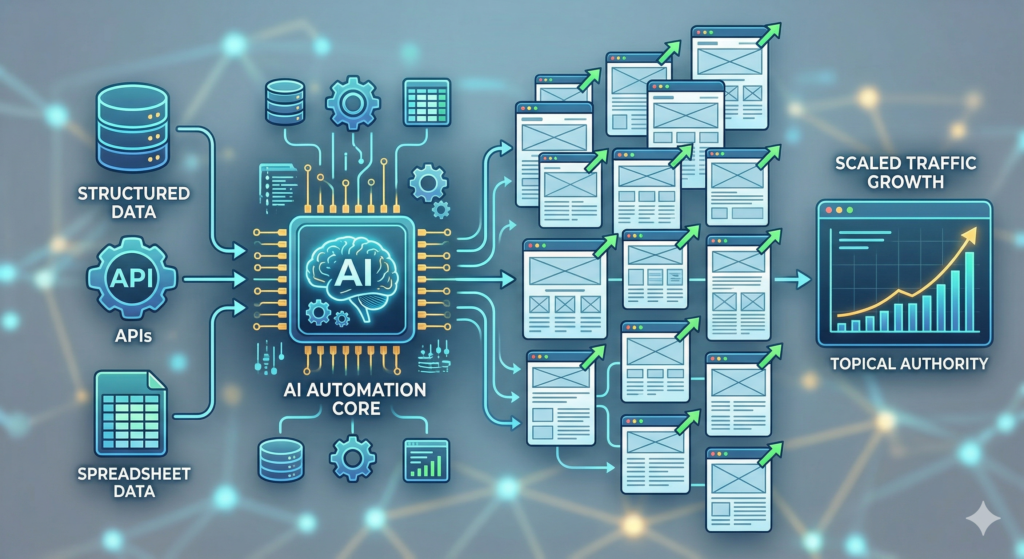
To execute Programmatic SEO effectively, you need to rely heavily on AI Automation. AI is no longer just a tool for writing generic paragraphs; it is the central nervous system of modern digital marketing strategies.
Predictive SEO is becoming a major trending methodology. By feeding historical search data and competitor analytics into AI models, you can identify rising search trends and content gaps before your competitors do. Furthermore, AI-Assisted Content Creation streamlines the most time-consuming aspects of page generation. You can use large language models (LLMs) to automatically generate comprehensive content briefs, structure your schema markups, and write highly optimized meta titles and descriptions for thousands of pages in a matter of minutes.
Another critical trend is Content Refreshing With AI Insights. Search algorithms favor fresh, updated content. Instead of manually auditing your website every quarter, automated AI tools can monitor your page performance, identify content that is losing traction, and automatically suggest or implement updates—such as adding new FAQs or updating statistics—to ensure your pages retain their rankings.
The Ultimate Tech Stack: WordPress, MPG, and CF7
You might assume that building a programmatic growth engine requires custom-coded, enterprise-level software. Fortunately, that is not the case. If you are operating on a robust CMS like WordPress, you already have access to the perfect foundation to start scaling immediately.
To generate pages at scale, tools like the Multiple Pages Generator (MPG) plugin are absolute game-changers. MPG allows you to upload a simple database—like an Excel or Google Sheets file containing your target keywords, locations, dynamic text, and image URLs—and instantly spin up thousands of interconnected landing pages. It essentially turns a single, beautifully designed WordPress template into an expansive, site-wide SEO net.
However, generating thousands of visitors is only half the battle; traffic is merely a vanity metric if it does not translate into revenue. You must capture that high-intent user interest immediately. This is where strategic lead generation comes into play. By embedding highly optimized, flawlessly styled Contact Form 7 (CF7) forms directly into your programmatic templates, you ensure that every dynamically generated page acts as a dedicated conversion trap. When a user lands on your highly specific page, they are immediately greeted with a clear, professional way to contact you, dramatically lowering your customer acquisition cost (CAC).
Targeting High-Intent Keywords and Entity-Based SEO
In 2026, the focus has shifted away from isolated keyword stuffing and moved entirely toward Entity-Based SEO. Search engines no longer view keywords simply as strings of text; they view them as interconnected concepts (entities). When building your programmatic database, your keyword strategy must reflect this.
You need to focus on mapping out intent ecosystems. The most successful programmatic sites utilize long-tail keyword patterns that signal strong buyer intent. Some of the highest-converting programmatic keyword patterns include:
Best [Software/Tool] for [Specific Industry][Competitor Alternative] vs [Your Brand]How to automate [Specific Business Process]
By clustering these interconnected topics, you build massive topical authority. Search engines begin to view your website as the definitive, encyclopedic source for your niche. Furthermore, leaning into First-Party Data SEO is becoming critical. As third-party cookies disappear, using your own proprietary data—such as user reviews, original case studies, and internal survey statistics—as dynamic variables in your programmatic pages makes your content entirely unique and impossible for competitors to accurately replicate.
Dominating Local Search and Your Google Business Profile.

For service-based businesses, local intent is the most powerful traffic driver on the internet. Integrating your programmatic strategy with local SEO creates an inescapable net for regional searches.
If your domain is, for example, https://iammahesh.in, your goal should be to capture search volume not just universally, but locally. By generating programmatic pages targeted at specific cities or neighborhoods, you create a localized digital footprint.
Crucially, this website strategy must run in tandem with a highly optimized Google Business Profile (GBP). When your programmatic landing pages rank organically in the standard search results, and your GBP ranks in the Local Map Pack for those exact same queries, you dominate the “above the fold” real estate on the SERP. To maximize this synergy, ensure that the NAP (Name, Address, Phone Number) data and the services listed on your dynamic programmatic pages match the data on your Google Business Profile exactly. This consistency sends massive trust signals to the search engine algorithms.
Future-Proofing with EEAT and Human Oversight
While AI automation and programmatic generation offer incredible scale, they must be managed responsibly. Google’s algorithms are exceptionally sophisticated at identifying robotic, unhelpful, or spammy content. The defining metric for success in 2026 is EEAT-Focused Branding—which stands for Experience, Expertise, Authoritativeness, and Trustworthiness.
Even when generating thousands of pages, you must inject real human experience. Pure AI generation without oversight will eventually result in penalized rankings. To maintain high EEAT scores across a programmatic site, you should:
Include Author Bios: Ensure every template attributes the content to a real digital marketing expert to establish credibility.
Inject Real Data: Use your programmatic variables to display real-world pricing, factual comparisons, and genuine client testimonials.
Prioritize User Experience: Fast loading times, clear navigation, and an aesthetically pleasing design are mandatory. If users bounce off your dynamically generated pages immediately, your rankings will tank, regardless of how well-optimized the text is.
The magic happens when you blend AI efficiency with human insight. Let the automation handle the heavy lifting of page generation, keyword clustering, and meta-tagging, but let your human expertise dictate the strategy, the template design, and the ultimate value proposition offered to the user.
Conclusion
Scaling website traffic in 2026 requires shifting your mindset from that of a content writer to that of a system architect. By embracing Programmatic SEO 2.0 and AI-Powered SEO workflows, you can stop chasing algorithms and start building scalable, automated growth engines. Leverage the power of your existing tech stack, focus intensely on long-tail user intent, and never lose sight of providing genuine value. The traffic is out there waiting for you; you just need to build the infrastructure to capture it.
